


How to uncover insights to grow your nonprofit
By Howard Adam Levy, Principal, Red Rooster Group
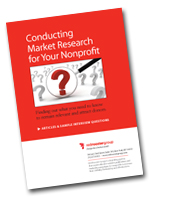 Download our PDF Guide to Conducting Market Research for Your Nonprofit. It contains the following article, plus a brand assessment, tips on conducting a competitive review, and separate lists of questions to ask your staff, donors and referral sources.
Developing an organization dedicated to advancing the public interest and successfully implementing these goals presents a unique set of challenges to new nonprofits. In this article, we’ll explain how you can define your nonprofit’s value, both internally and externally, by researching what similar organizations are doing, how they are doing it, and whether or not your nonprofit has what it takes to stand out and build a following.
Reliable research helps you create a map to guide you in defining your mission relative to similar organizations and in locating and tapping resources. Knowing that your agency offers distinct, rewarding benefits sustains internal motivation and engages donors and other supporters.
What You Need to Know
Every nonprofit starts with an idea sparked in response to a need.
- A family whose child suffers from a rare, incurable disease forms an organization 
to raise money for medical research aimed 
at a cure.
- A hospital creates a nonprofit foundation 
to help patients without insurance get the care they need.
- An urban neighborhood forms an alliance 
to raise money for green spaces where 
residents can grow gardens and build 
safe playgrounds.
Regardless of its origins, a nonprofit flourishes only when the founders and their stakeholders are confident in the value of their unique, compelling purpose.
While you may think your mission, audience or model is unique, chances are that it isn’t. With one million nonprofits in the U.S., many address similar issues or respond to similar needs.
As a result, nonprofits need to find ways to maneuver through the crowd to acquire funding and supporters. Too many of the same type of organization also confuses the public. If they can’t tell the difference between your nonprofit and others, how can they decide which is worthy of their time, energy and money?
Take, for example, Susan G. Komen for the Cure and the Avon Foundation’s Walk for Breast Cancer. Both organizations support community-based events focused on raising money for breast cancer. Funds from the 
Komen race support research aimed at 
finding a cure for the disease. Proceeds from the Avon events also support research, but most contributions are used to give medically under-served women and men diagnosed 
with breast cancer access to much-needed screening, support and treatment.
Market Research Basics
Research helps you discover the who’s who within the universe of similar nonprofits. Spending a few hours on the Internet searching for like-minded organizations gives you the first set of directions in deciding where you stand among your peers.
Additionally, you’ll need to do more in-depth analysis of similar nonprofits by:
- Talking with funding sources that give money to similar organizations and learning why they support these groups.
- Speaking with stakeholders at other 
nonprofits within your sphere to find out what other resources are needed to help 
the cause and how they are willing to help.
- Reviewing industry-related publications and media coverage of like-minded nonprofits 
to learn their story and how they are telling it.
- Visiting sites like Charity Navigator 
or Guidestar to gather funding and 
organizational data of other nonprofits.
• 
Studying marketing and communications materials from other organizations to learn their “language†and how they visually 
present themselves to their audience.
After completing your research, it’s time to reexamine your own messaging and mission:
- Are you meeting an unmet need?
- Are you distinct and remarkable?
- Is your offer to donors and members 
compelling?
- Do you do a good job telling your story?
If you can clearly communicate your unique advantage at solving a problem or meeting a need, you’ve successfully differentiated your organization from the crowd and have a better chance of engaging support.
But, if research leads you to discover that your organization is simply vanilla, one of too many others, sustaining your nonprofit will likely be an ongoing and long-term challenge.
The More You Know
Other valuable research tools can help further sharpen your focus and establish your niche.
• Internal: Involve your staff, board members and volunteers in assessing your nonprofit’s strengths, weaknesses and values. Ask your staff to explain your nonprofit’s mission. Is everyone on the same page, or are you getting different responses? Make sure your vision and value have traction internally so that everyone is singing the same song.
• External: Talk with members, donors and clients to find out their perceptions of your organization’s purpose. Their answers will help you identify both challenges and opportunities in communicating your brand message.
• Qualitative: Focus groups and formal interviews allow people to share their experiences with your organization, their passion for the cause and what they are willing to do to support your purpose. Where do they get information related to your nonprofit’s purpose? Do they go online, read newspapers or join clubs? Are people enthusiastic and motivated about the work your organization does or are they burned out? While anecdotal, the information can be very powerful in helping you solve problems and develop new approaches.
• Quantitative: Based on statistical data gathered from a large number of people, this type of research is typically conducted through surveys. Online, telephone and mail questionnaires, the most common types of tools used in quantitative research can help you assess what issues or services have broad-based support.
• Ethnographic: The purpose of ethnographic research is to uncover the actual habits and behaviors of people as they experience your organization rather than what they may say in response to a survey. By connecting with people based on their beliefs and behaviors, you’re much more likely to make a deep and meaningful connection with them and move them to action. The concept of ethnographic research was used successfully in motivating Third World country residents to use soap to prevent the spread of diseases by uncovering what local people believe is dirty. You can find out more about this fascinating campaign at globalhandwashing.org.
Understanding your stakeholders more deeply and assessing your message, mission and value shows you where you fit in the world of nonprofits. Research helps you take stock, test theories and make clear decisions about your organization’s direction to guide your long-term success.
Howard Adam Levy is the principal of Red Rooster Group, branding, marketing and design firm based in New York City serving nonprofits nationwide. Red Rooster Group helps nonprofit organizations to improve their visibility, communications and fundraising efforts by developing effective strategy, websites, email campaigns and other forms of marketing outreach. For help improving your brand, contact info@redroostergroup.com.
LINKS
- Assessing Your Nonprofit Brand
- The Board’s Role in Managing Your Nonprofit’s Brand
- See case studies of nonprofit brands.
- Get help with your nonprofit brand.